A Jinhua Hospital (Zhejiang University) review maps 2023–2025 progress in stem-cell therapy for atherosclerosis — mechanisms, early trials and targeted delivery.
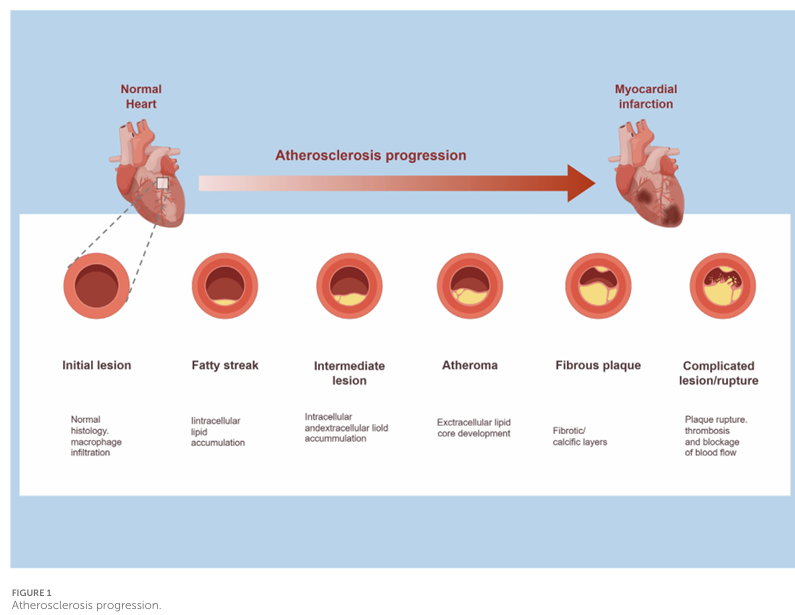
More than 17.9 million people die of cardiovascular disease each year. Atherosclerosis (AS) is the leading pathological basis of cardiovascular disability and death worldwide. Statins and stents can slow the disease; they cannot repair vessels already damaged. Regenerative medicine, and stem cells’ multilineage, immunomodulatory and repair properties, are opening a new path.
A review from Jinhua Hospital, affiliated to Zhejiang University School of Medicine, in Frontiers in Cell and Developmental Biology, maps 2023–2025 progress — from mechanism to clinic, from problems to solutions — as a blueprint for vessel repair.
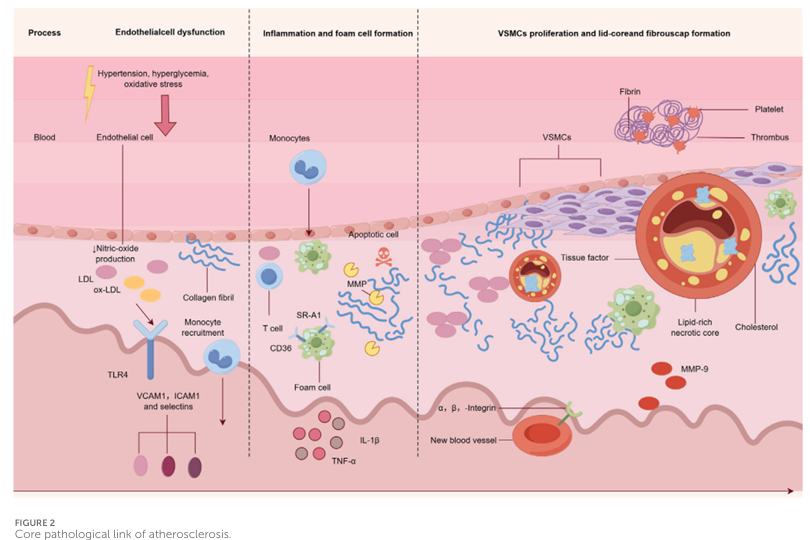
Atherosclerosis is a vicious cycle of lipid deposition plus chronic inflammation in the wall:
The endothelial barrier fails: hypertension, high glucose and smoking crack the smooth endothelial “wall” — cells die, gaps widen, LDL-C slips in and is oxidised to ox-LDL.
Inflammation adds fuel: oxidised lipid draws monocytes; immune cells lose control, become foam cells packed with fat, release inflammatory factors and summon more cells into a chronic inflammatory melee.
Plaque forms and the vessel turns brittle: fat from dying foam cells forms a lipid core, wrapped by a fibrous cap of smooth-muscle cells. Ongoing inflammation thins the cap so it may rupture and form a thrombus.
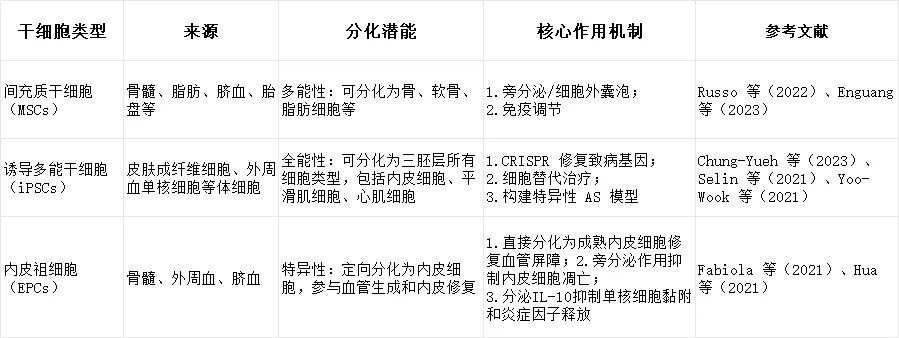
A 2024 I/II trial in J Am Coll Cardiol reported that 32 patients given a single AD-MSC infusion had no serious adverse events in six months; mean carotid IMT fell 0.18 mm, LDL fell 19% and HDL rose 23%.
A 2025 Nature Medicine phase I study of local iPSC-VEC infusion (n=10) reported FMD rising from 4.2% to 7.8% and plaque-stability improvement in 80%.
Single-cell sequencing to pick MSC subtypes, such as IL-10⁺ MSCs or those with strong endothelial potential.
Organoid models from a patient’s own iPSCs, mimicking subendothelial lipid and macrophage infiltration.
Targeted delivery such as anti-VCAM-1 antibody-modified PLGA microspheres, raising stem-cell enrichment from 2% to 25%.
With the ability to repair vessels, suppress inflammation and stabilise plaque, stem cells have shown encouraging safety and efficacy in basic work and early trials.
Life science and genetic technology are developing rapidly. This article is compiled from publicly available educational material, for reference only, and does not constitute medical advice. For medical questions, please consult a qualified clinician.