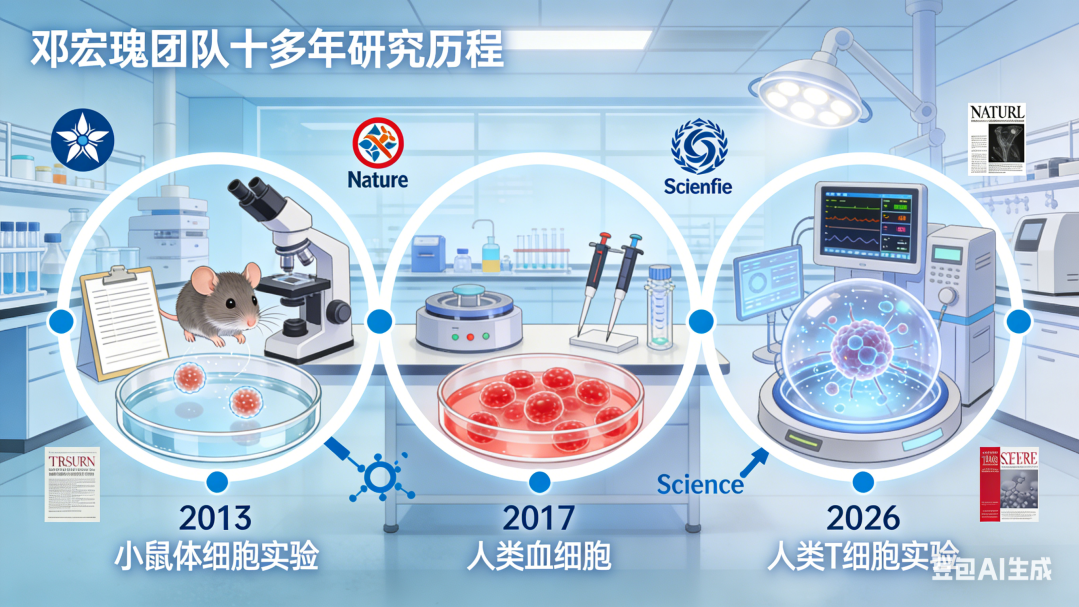
Deng Hongkui’s team used small molecules to turn human T cells into pluripotent stem cells that can be redifferentiated into young, cancer-specific T cells.
T cells sit at the core of adaptive immunity. Through the T-cell receptor (TCR) they recognise and attack cancer cells and virus-infected cells. Adoptive immunotherapies built on them — CAR-T, TCR-T and others — have already shown clear results in cancer and autoimmune disease. Two bottlenecks have long constrained them: antigen-specific T cells expand only in limited numbers in vitro and readily exhaust, and anti-cancer specific T cells are hard to enrich, so treatment is costly and unstable.
On 16 January 2026, Academician Deng Hongkui’s team at Peking University published a major study in Cell Research: the first efficient conversion of human T cells into pluripotent stem cells by chemical reprogramming, which can then be redifferentiated into young T cells that keep anti-cancer specificity. The breakthrough may unlock the shortage of T-cell source and exhaustion, and pave the way for “off-the-shelf” T-cell therapy.
The core of the work is to “reset” antigen-specific T cells to pluripotent stem cells (PSCs) — cells with unlimited self-renewal that can become any cell type, like turning ageing professional “immune soldiers” back into endlessly copyable, retrainable “recruits”.
Traditional transcription-factor reprogramming is extremely inefficient in human T cells, almost unworkable. Deng’s team took a different path: a purely chemical small-molecule strategy, regulating cell state with a drug combination and no foreign genes, with a large gain in safety and control. The team had already reprogrammed mouse and human cells this way; this time they optimised the method for terminally differentiated T cells.
The key was breaking the “defence” that keeps T-cell identity stable. Screening showed that adding the EZH2 inhibitor EPZ6438 (targeting an epigenetic regulator) can dismantle that identity barrier, turning T cells into epithelial-like cells and activating pluripotency genes. Reprogramming proceeds in stages: early on, a small-molecule “cocktail” containing the EZH2 inhibitor induces T cells to cluster and lose their original features; later, pluripotency genes are activated, yielding T-cell-derived chemically induced pluripotent stem cells (hT-CiPS). Efficiency far exceeds traditional methods — hundreds of stem-cell clones from every 80,000 T cells.
These hT-CiPS cells match human embryonic stem cells closely in morphology and gene expression. More important, they fully retain the TCR gene rearrangements of the original T cells. The TCR is the T cell’s “identity card” for antigen recognition. Sequencing confirmed that each hT-CiPS line has a unique TCR rearrangement peak, from a different parental T cell, so the diversity of a T-cell repertoire can be captured at scale.
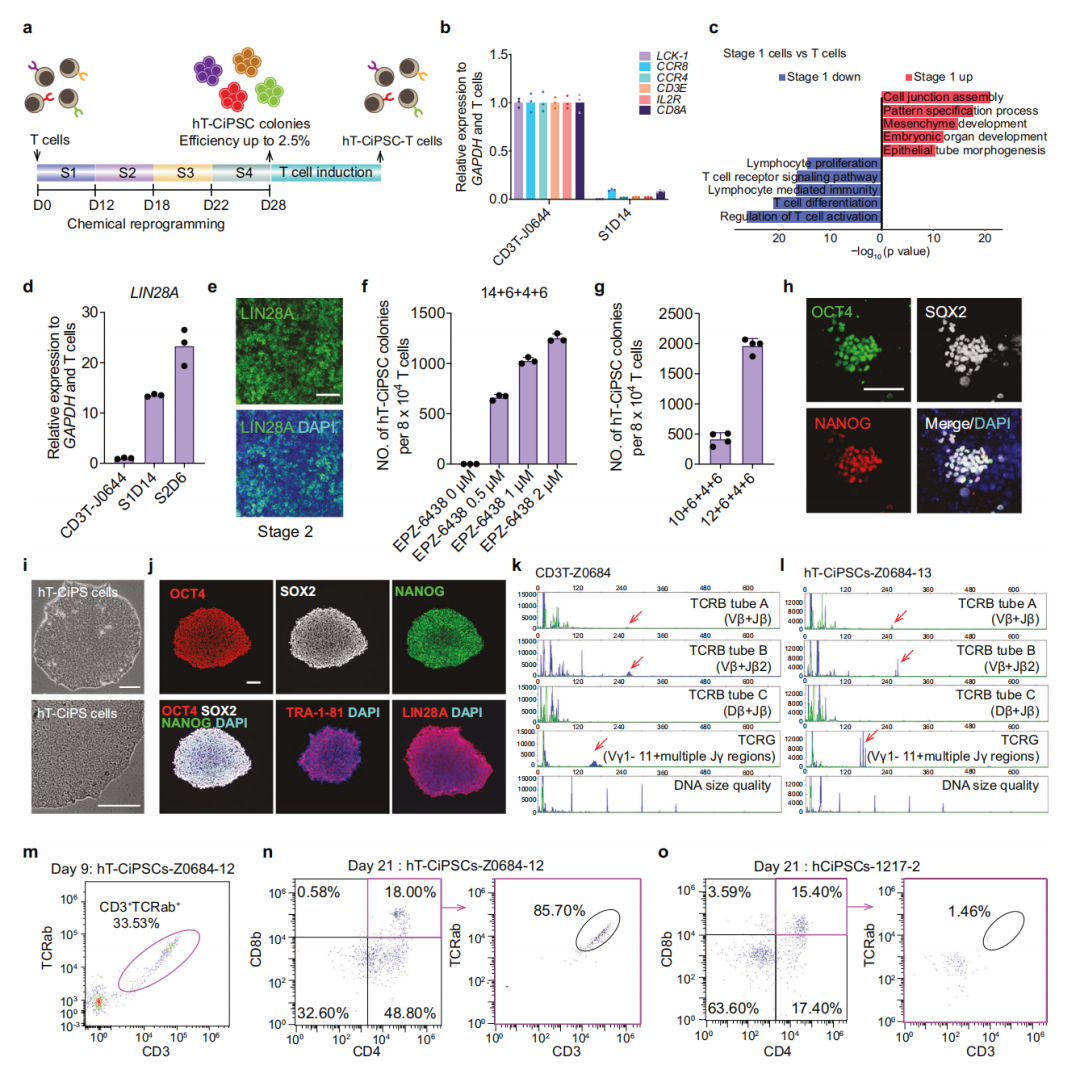
Still more striking, hT-CiPS cells can be redifferentiated efficiently into functional T cells. Using a stromal-cell culture system that mimics in-vivo development, the team induced CD3+ T cells expressing TCR, with higher differentiation efficiency than stem cells from other sources, and 99.8% of the new T cells had TCR sequences identical to the parental hT-CiPS cells — faithful inheritance of antigen specificity.
The chemical-reprogramming platform has clear strengths: on safety, pure small-molecule handling with no gene-integration risk and a process easy to standardise; on diversity, TCR diversity captured at scale, a foundation for a multi-target anti-cancer “T-cell library”; on editability, hT-CiPS cells are readily gene-edited, with potential to strengthen anti-cancer capacity and lower rejection.
The team says the technology may enable industrial production of “off-the-shelf” T-cell products — without taking T cells from the patient, a stem-cell bank could mass-produce high-quality specific T cells, sharply cutting cost and waiting time. The study shows the power of chemical reprogramming to control cell fate, and opens a new direction in regenerative medicine and immunotherapy.
Life science and genetic technology are developing rapidly. This article is compiled from publicly available educational material, for reference only, and does not constitute medical advice. For medical questions, please consult a qualified clinician.